Safety Talk: 15 Topics and Methods for Teams That Really Listen in 2026
On average, a safety officer leads one safety talk per week. That adds up to 52 presentations a year, to the same teams, often covering the same risks. The real challenge isn’t figuring out what to say the first week. It’s getting through the fifty-second one.
This guide brings together 15 topics ready for use in 2026, a method for engaging teams, and an approach that few companies take advantage of: visual aids that turn a casual chat into a much-anticipated event.
What is a safety talk?
A safety talk is a short, informal prevention meeting held directly on-site that addresses a single safety topic in ten to fifteen minutes. It takes place as close as possible to the workstation—in the workshop, on the job site, or in the break room.
The term is related to the “safety quarter-hour.” The quarter-hour is the traditional, structured format, often scheduled for the same time slot each week. The “safety discussion” refers to a more flexible and conversational format: participants exchange ideas, give a voice to those on the job site, and start with a real-life situation. The OPPBTP recommends holding these sessions weekly in the construction industry, led by the foreman and focusing on a specific risk at the current job site. In manufacturing, the frequency varies from weekly to monthly depending on the site.
What are the objectives of a safety briefing?
A safety briefing has four objectives. It maintains vigilance over the long term, because risk awareness erodes with habit. It brings information up from the front lines, since operators see situations that management never sees. It reinforces proper reflexes through spaced repetition, which is far more effective than annual training. Finally, it builds the company’s safety culture—the foundation that the ICSI describes through three pillars: technical reliability, safety management systems, and organizational and human factors.
This discussion focuses specifically on the third pillar—the one that is most difficult to address. Equipment is certified; procedures are audited. People, on the other hand, are the ones who take the plunge. That is the central challenge addressed by the 15 topics that follow.
The 15 Safety Talk Topics for 2026
Each topic below can be covered in a 15-minute discussion. The opening question is meant to kick off the discussion: we let people speak first before explaining.
1) Road Safety and the Commute
Traffic accidents remain the leading cause of workplace fatalities in France. The commute to and from work is part of that, and almost no one talks about it. To start things off: Who has replied to a text message while driving this week?
2) Routine and overconfidence
Accidents happen to both veterans and newcomers alike. Ten years of experience in a job leads to automatic responses, and automatic responses create blind spots. To start off: What’s the last step you skip because you’ve done it a thousand times?
3) PPE: Make Sure to Wear It
Everyone knows the rule. A meaningful conversation doesn’t just restate the rule; it explores why people break it: the heat, discomfort, or a 30-second task. Opening question: In what specific situation do you take off your gloves?
4) Movements, Postures, and Musculoskeletal Disorders
Musculoskeletal disorders account for the majority of recognized occupational illnesses. An effective discussion takes place at the workstation, with a hands-on demonstration of proper handling techniques. Opening question: Where do you feel pain at the end of the day?
5) Working at Heights
Falls from heights remain among the most serious types of accidents. The discussion should start with a specific example from the worksite: that ladder, that platform, that guardrail. Opening question: Where on the worksite do you never feel completely safe when climbing?
6) Storage and Energy
Electrical, hydraulic, pneumatic: a machine that’s stopped isn’t a machine without power. To start things off: Tell us about a time when a machine moved when it wasn’t supposed to.
7) On-site coactivity
Contractors, temporary workers, delivery drivers, vehicles, and pedestrians all cross paths. Everyone knows their own risks, but no one knows the risks faced by others. Here’s a thought-provoking question: Who knows exactly what the team working next to yours is doing this week?
8) Heat, Cold, and Weather
Heat waves are becoming more intense, and regulations are evolving along with them. Hydration, staggered work schedules, signs of heatstroke—this topic deserves its own discussion at the start of every summer. To start things off: At what temperature do you think work arrangements should be adjusted?
9) Psychosocial Risks and Mental Load
The topic goes beyond the traditional scope of a casual conversation, and that is precisely why it resonates. Fatigue, burnout, isolation: spending fifteen minutes discussing these issues gives the topic its legitimacy. Opening question: What, to you, is a good day at work?
10) Addictions in the Workplace
Alcohol, marijuana, medications, screens. This topic requires tact and a non-punitive environment. The discussion is meant to inform and provide guidance, not to judge. Opening question: In your opinion, who here can we talk to about this without any risk?
11) First Aid: The First Five Minutes
Who calls for help? Who stays behind? Where is the defibrillator? What do we tell 15? A simulation-based discussion is worth more than any poster. Opening question: If I were to collapse right now, who would do what?
12) Near-misses: Report Them
For every serious accident, dozens of near-misses go unreported. Every report is a free lesson. Open communication must remove the main obstacle: the fear of being seen as a whistleblower. To get the conversation started: Tell us about the last time you thought to yourself, «That was a close call.».
13) Organization, Traffic Flow, and 5S
Slips and trips are among the most common and preventable accidents. A cable, a puddle, a cardboard box on the floor. Opening question: Take a photo of the problem spot in your area and bring it to the discussion.
14) New Hires and Temporary Employees
Statistically speaking, new employees are most at risk of accidents during their first few months. The orientation session is being prepared, and the mentoring program is being formalized. As a way to reach out to veteran employees: What would you have liked someone to tell you on your first day?
15) End of the year, fatigue, and letting up
December brings a combination of fatigue, year-end goals, and a mind that’s elsewhere. Accident statistics tend to rise during this time of year. Opening question: What do we allow ourselves to do in December that we wouldn’t allow ourselves to do in March?
How can you lead a safety talk that leaves a lasting impression?
The method is based on five principles. One topic per discussion: fifteen minutes are enough to reinforce an idea, and three topics in fifteen minutes won’t reinforce any of them. Get people talking before you explain: An opening question turns a presentation into a conversation, and what participants articulate themselves sticks ten times better than what they’re told. Start with a real-life example from the workplace: a near-miss from the week, a photo taken in the workshop, a company statistic. Vary the formats throughout the year: quizzes, photo-language exercises, on-the-job demonstrations, simulations. Conclude with a concrete commitment: a single action, decided together, and followed up on at the next meeting.
These five principles address the fundamentals. There remains one lever that almost all companies overlook, even though it determines everything else: what the teams see.
The medium is half the conversation
Fifty-two talks a year means fifty-two presentations. Most companies draw from the same stock image libraries: yellow pictograms, stock photos of hard hats, and generic silhouettes. These images all look alike, and the brain has learned to ignore. It is the same mechanism that makes us blind to the posters security measures that have been in place on the walls for years.
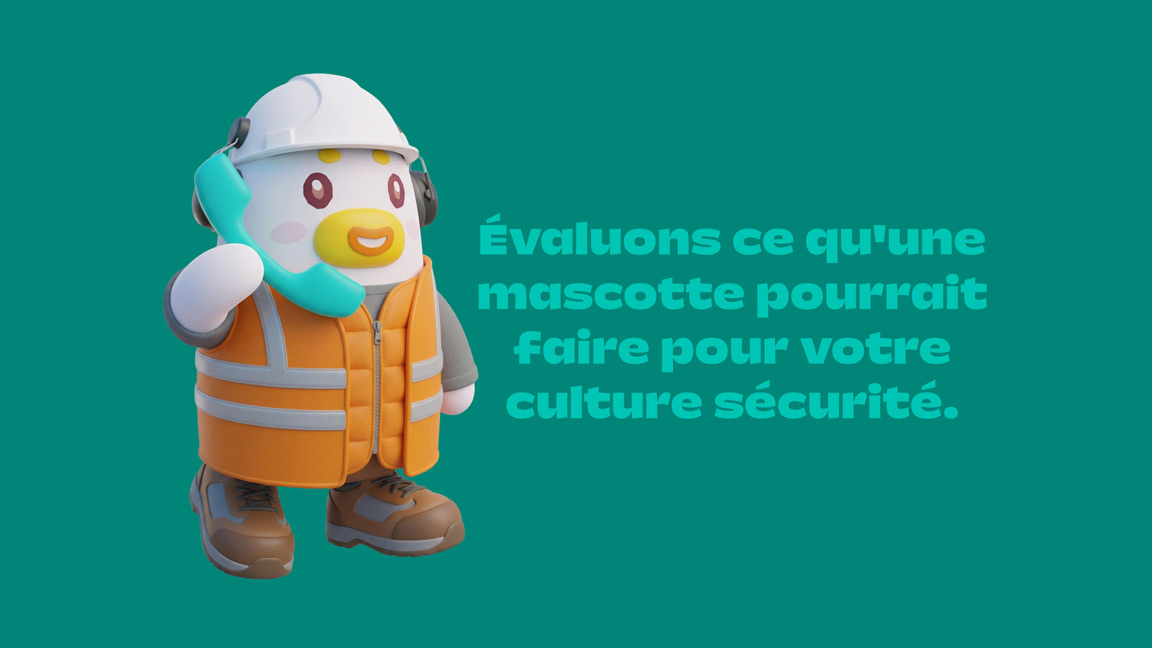
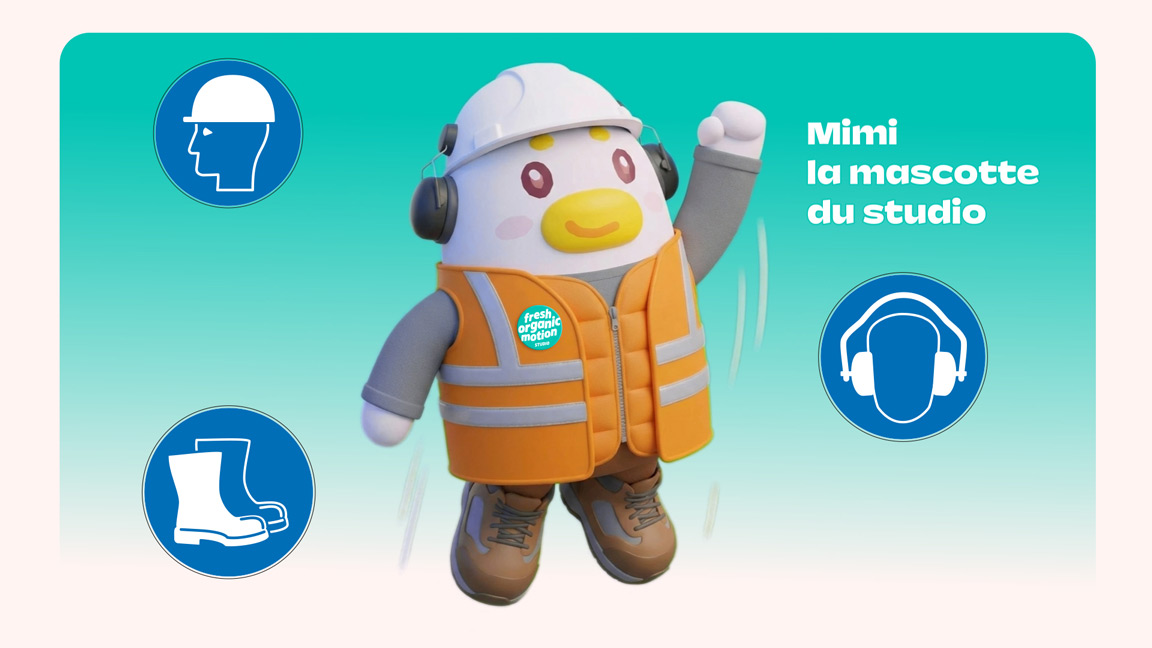
There is another way: put a face on prevention. A recurring character, Created for the company, he embodies the message conveyed in each talk. The same hero returns every week in a new situation, and his presence creates a visual tradition. You recognize him from a distance on the poster; you smile; you look.
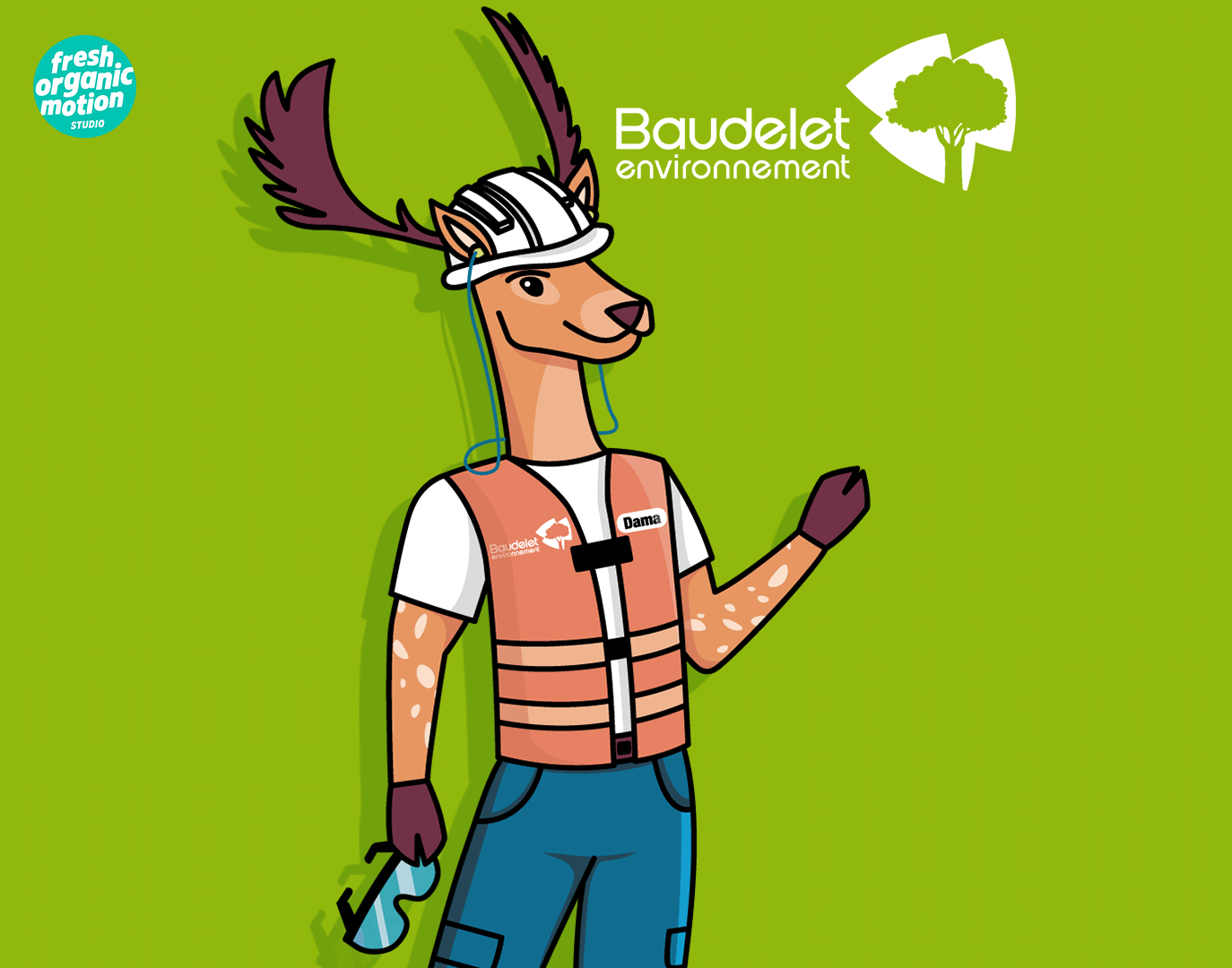
That's the path he took Baudelet Environment, a company in the industrial sorting sector, with its safety mascot. The character embodies safety and the care provided to employees at sites where the risks are very real. The results: safety guidelines are better understood and followed, and a sense of unity has developed around the character among the field teams.
The character’s strength lies in the fact that it extends beyond the morning meeting. It lives on the slides shown during the 15-minute session, on the posters in the locker room, and then on mugs, T-shirts, and the cardboard calendar we take home. The mascot becomes part of everyday life, almost like a coworker. And when we see it appear on the Monday talk session materials, we’re happy to see it again, because it’s part of the family. A safety message delivered by someone we care about is received differently than a top-down directive.
This character is custom-designed based on the company’s culture and line of business. To understand how such a character is created and implemented, the page dedicated to the workplace safety mascot details the entire process.
Where does conversation come from, and where is it headed?
The “safety quarter-hour” originated in industry and the construction sector as a top-down ritual: the supervisor speaks, the teams listen, and everyone signs the sheet. This format has fulfilled its historical role and revealed its limitation: passive listening. The participatory discussion has enriched it: we give a voice to those on the front lines, we start from reality, and we engage everyone.
The future is already taking shape. Micro-learning breaks down safety training into short, regular sessions. Gamification turns safety quizzes into team competitions. And these platforms take on a life of their own: characters, internal miniseries, and avatars that convey the messages. The 2030 chat will feel less like a meeting and more like an episode we’re looking forward to.
The safety briefing is one of the few times the company talks to its teams about what really matters: getting home safe and sound. This moment deserves more than just a generic icon. Give it a face, and your teams will come to the talk just as they would to meet someone they know.
What if your talks had a face?
A public awareness ambassador turns 52 talks a year into eagerly anticipated events.
Tailored specifically to your business and your risks, it appears on your promotional materials, posters, and even on the team’s mugs. You have full ownership of it.
Meet the Safety MascotFAQ
Both terms refer to a brief prevention session in the field. “Safety quarter-hour” is the traditional term, associated with a structured, 15-minute session held at a fixed time. “Safety talk” refers to a more flexible and conversational format focused on discussion. In practice, the two terms are often used interchangeably.
Between ten and fifteen minutes. Any shorter, and the conversation doesn’t have time to get going. Any longer, and it turns into a meeting, and people’s attention starts to wander. The best approach is to keep it short rather than extend it.
No law specifically requires safety briefings. However, the Labor Code imposes a general obligation on employers to provide safety information and training. Safety briefings are one of the most widely recognized ways to fulfill this obligation, and the OPPBTP explicitly recommends them in the construction industry.
Ideally, the team leader or line manager. A safety message delivered by direct management carries more weight than one from the safety officer alone, because it demonstrates that safety is a priority for management. The safety officer prepares the content, trains the facilitators, and provides input on technical matters.
Formats that rely on something other than speech can be very liberating: voting with colored cards, bringing a photo of your neighborhood, or reacting to a visual. Asking an open-ended question directed at the group rather than at an individual avoids putting anyone on the spot. And a strong visual aid provides a shared focus for discussion, which is easier than talking about oneself.
A single powerful image is better than a ten-slide presentation. A photo from the field, a simple diagram, a one-question quiz, or a visual featuring a recurring public awareness character. The ideal visual is instantly recognizable and sparks a conversation rather than replacing it.